NeuroRenderedFake: A Challenging Benchmark to Detect Fake Images Generated by Advanced Neural Rendering
Methods
The remarkable progress in neural-network-driven visual data generation, especially with neural rendering techniques like Neural Radiance Fields and 3D Gaussian splatting, offers a powerful alternative to GANs and diffusion models. These methods can generate high-fidelity images and lifelike avatars, highlighting the need for robust detection methods. However, the lack of any large dataset containing images from neural rendering methods becomes a bottleneck for the detection of such sophisticated fake images. To address this limitation, we introduce NeuroRenderedFake, a comprehensive benchmark for evaluating emerging fake image detection methods. Our key contributions are threefold: (1) A large-scale dataset of fake images synthesized using state-of-the-art neural rendering techniques, significantly expanding the scope of fake image detection beyond generative models; (2) A cross-domain evaluation protocol designed to assess the domain gap and common artifacts between generative and neural rendering-based fake images; and (3) An in-depth spectral energy analysis that reveals how frequency domain characteristics influence the performance of fake image detectors. We train representative detectors, based on spatial, spectral, and multimodal architectures, on fake images generated by both generative and neural rendering models. We evaluate these detectors on 15 groups of fake images synthesized by cutting-edge neural rendering models, generative models, and combined methods that can exhibit artifacts from both domains. Additionally, we provide insightful findings through detailed experiments on degraded fake image detection and the impact of spectral features, aiming to advance research in this critical area.
Breif Description

A comparative summary of our database and other related or widely-used fake image detection datasets is presented in Table 1. The previously popular databases listed in Table 1 do not include neural-rendered fake images. In contrast, our dataset offers a comprehensive collection of fake images generated by various types of neural rendering methods, including those combined techniques that integrate artifacts from both neural rendering and generative models. Notably, generating 3D scenes and projecting them onto a 2D view plane is computationally expensive and must be built from scratch. Comprehensive descriptions of the dataset and experimental protocols can be found in the supplementary file accompanying our accepted paper [1].
More Data Samples of NeuroRenderedFake
We visualize fake image samples generated by exclusive NeRF/3DGS from NeuroRenderedFake, along with their corresponding camera poses, all belonging to the same 3D scene.

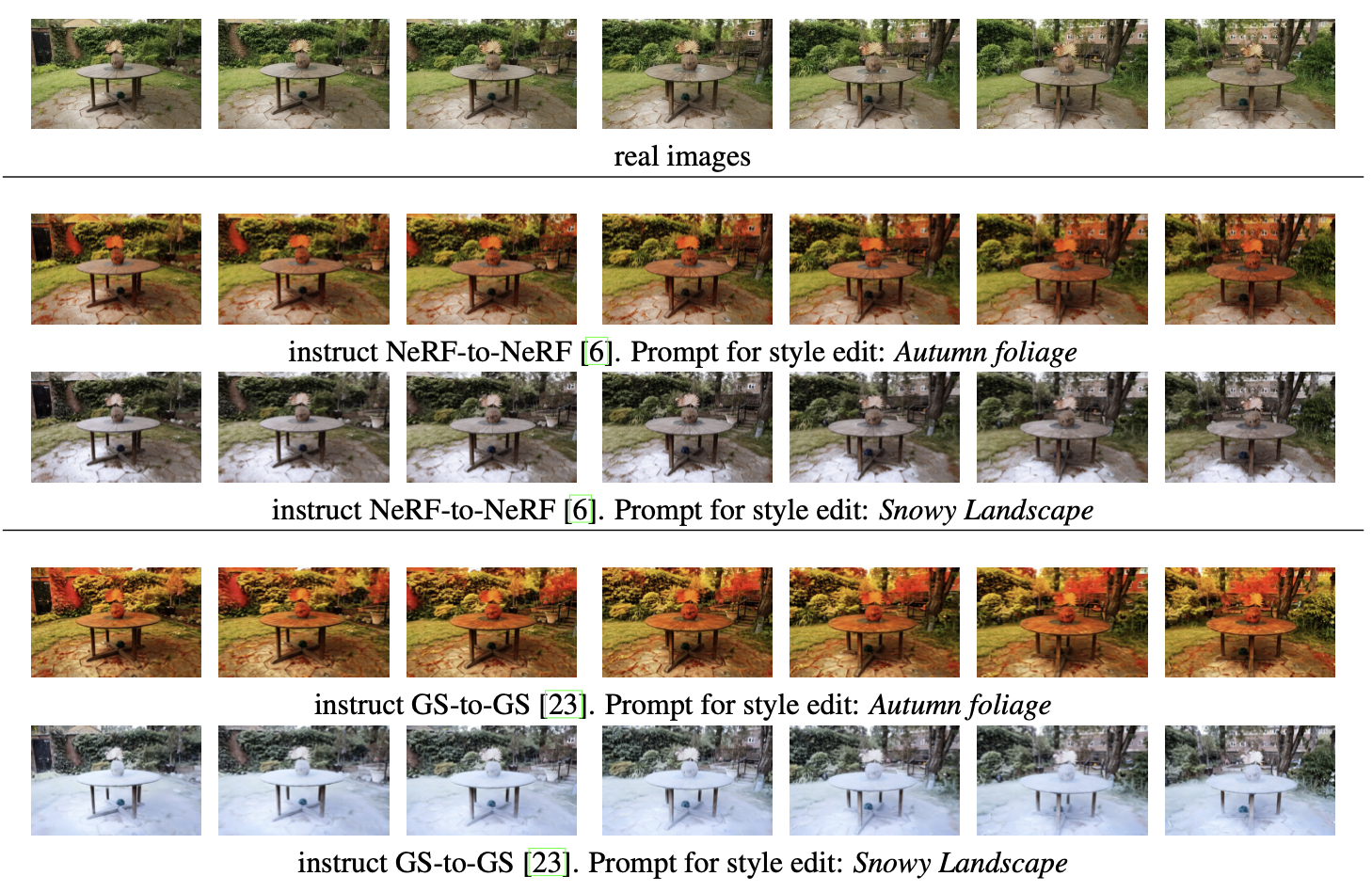
Similarly, we also present fake image samples from the database for the performance evaluation and are generated by a variety of 3D-realistic image synthesis methods, including editable NeRF, editable 3DGS, and combinations of NeRF/3DGS with traditional generative models, extending beyond simple NeRF-based and 3DGS-based approaches.
Fake talking face videos that generated by GeneFace++
Fake videos that generated by Runway
Fake talking face videos that generated by Gaussian Talker
Download and
Copyright
The database is being made available for the researchers from Sep 2025 onwards. Interested researchers should follow following steps to acquire "NeuroRenderedFake: A Challenging Benchmark to Detect Fake Images Generated by Advanced Neural Rendering Methods"
-
Please visit the
online
Harvard
Dataverse
and cite our paper;
All the rights of the The NeuroRenderedFake: A Challenging Benchmark to Detect Fake Images Generated by Advanced Neural Rendering Methods are reserved and commercial use/distribution of this database is strictly prohibited. All the technical reports and papers that report experimental results from this database should provide due acknowledgement and reference [1]. Questions regarding this database can be directed to Ajay.Kumar@polyu.edu.hk.
References
[1] Chengdong Dong, Vijayakumar Bhagavatula, Zhenyu Zhou, and Ajay Kumar. "NeuroRenderedFake: A Challenging Benchmark to Detect Fake Images Generated by Advanced Neural Rendering Methods," Advances in Neural Information Processing Systems, 2025.
Back to
Databases
Page